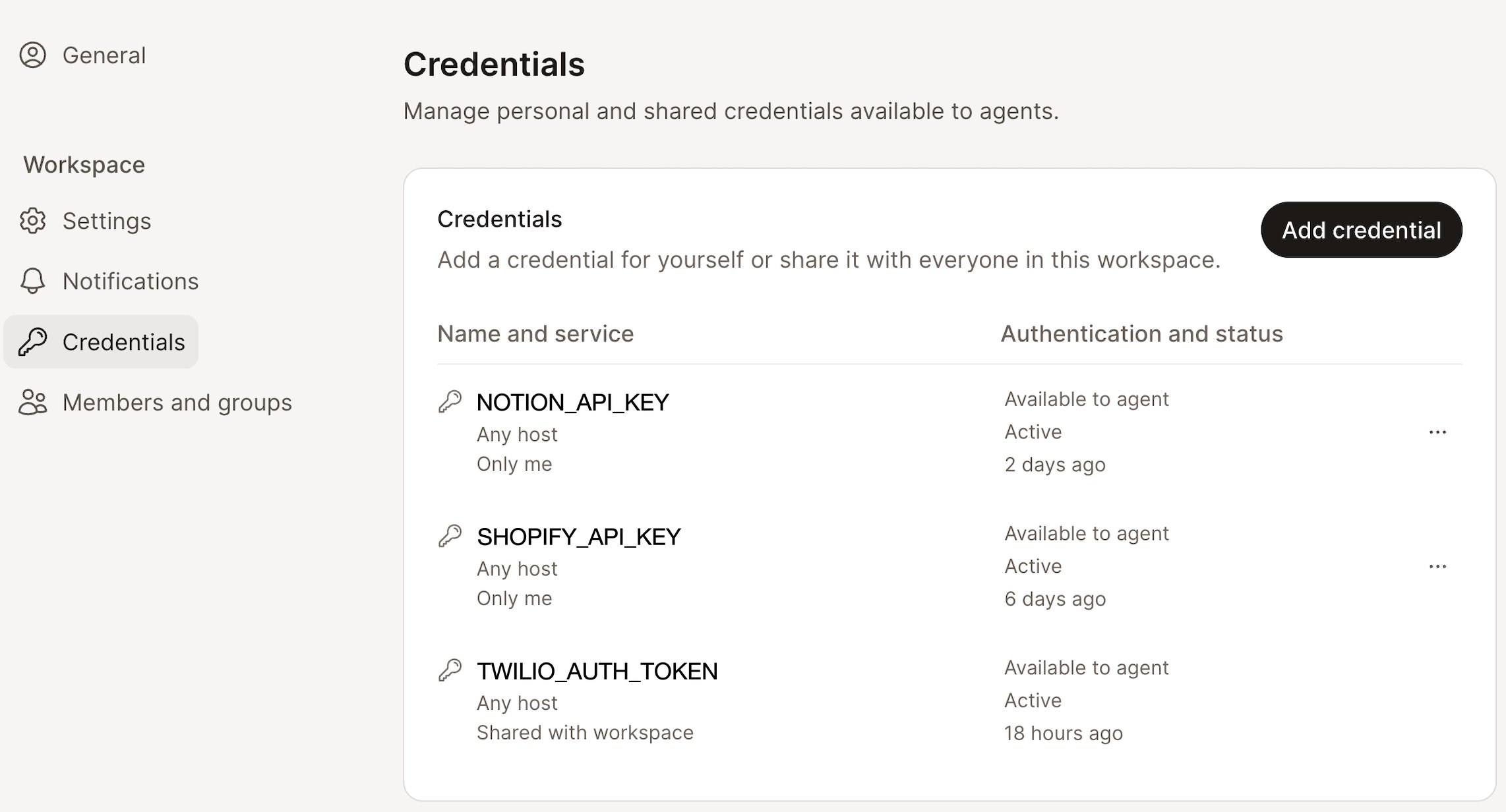
The Credentials page in Settings, listing stored credentials with their host, visibility, and status
Some tools don’t hand you an OAuth button. They hand you an API key. A credential is where that key lives: you save it once, Lindy uses it when it needs it, and nobody has to paste the key into a message again. Credentials are what Lindy reaches for when it runs shell commands and code. If you’ve asked it to hit an API directly rather than through a connected tool, this is where the credential for that call comes from. A credential starts as yours. Save a key and only you can use it, until you choose to share it with everyone in the workspace.

Adding a credential

1

Open Credentials

Go to Settings, then Credentials under Workspace.
2

Add a new credential

Click Add credential, then fill in the name and the value.
3

Save

The credential is available to your agents right away.
The name is how you and Lindy refer to the key later, so make it obvious what it opens. Existing credentials follow SCREAMING_SNAKE_CASE:

Reading the list

Each row tells you two things: what the credential is, and whether it’s working. A rotated credential is easy to spot: its updated time moves, its name doesn’t.

Rotating and sharing

Open the menu on any credential row.
The actions menu on a credential row, offering Rotate value, Share with workspace, and Revoke
Rotating and sharing are separate decisions. Rotating a shared credential keeps it shared: everyone simply starts using the new value.

What Lindy shows you, and what it doesn’t

A saved credential’s value is write-only. You can see that a credential exists, what it’s called, who it’s shared with, and when it was last updated. You cannot read the value back: not in the app, not through the API, not by asking Lindy.
Because values can’t be read back, Lindy has no “show me the key” escape hatch. Keep the original somewhere you control, like a password manager. If you lose it, rotate the credential with a fresh key from the tool it came from.

Credentials and integrations

Credentials and integrations solve the same problem from different ends. If the tool you want is already in the integrations list, connect it there. Reach for a credential when the thing you’re calling has no integration of its own.